
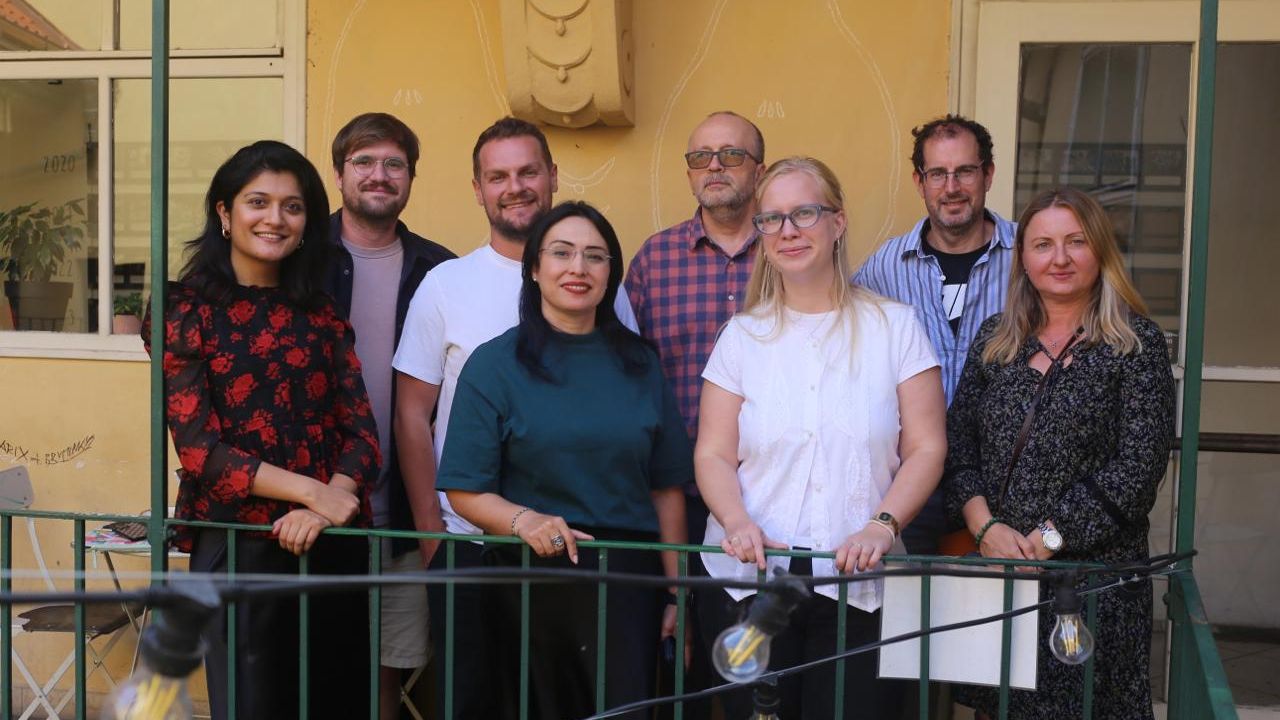
We’re excited to welcome the second cohort of our program From Division to Dialogue: Complicating the Narrative, bringing together GoGo.al from Albania, Kosovo 2.0 from Kosovo, Magyar Hang from Hungary, EkoNews and Okraj from the Czech Republic.
The journalists came together in Prague on 9–10 September for an intensive two-day training. Through practical exercises, case studies, and discussions, they explored the pillars of the Complicating the Narrative (CTN) methodology, including techniques for deeper listening and interviewing, approaching polarizing subjects with greater nuance, and finding complexity within seemingly opposing positions.
At a time when public debates are increasingly reduced to opposing camps, journalism can either reinforce those divisions or help audiences better understand the people, experiences, and motivations behind them. CTN offers practical tools to move beyond binary narratives, listen more deeply, and create space for complexity while maintaining journalistic rigor.
This second cohort builds on the work we began in 2025, when Transitions launched its first CTN pilot with five newsrooms across Europe. Now, a new group of journalists is taking that work forward.
What did participants think?
For Valmora Gogo, founder and journalist at GoGo.al, the workshop was also an opportunity to reflect on the fundamentals of reporting:
“Reporting on political issues greatly benefits from using these techniques. Above all, however, it requires us to open our minds, to look beyond the surface, listen more carefully, and understand.”
For Karolína Chlumecká, journalist at EkoNews, the approach felt particularly relevant to reporting on climate change, an issue that itself has become increasingly polarized:
“I think CTN is a really interesting and valuable approach to journalism, and one that is more important than ever right now. The training came at a very good time for me. Climate change is a topic that increasingly divides society, and as journalists covering climate and environmental issues, we have to think about how to report on them in a way that doesn’t deepen those divisions, but can instead help create space for a more constructive conversation.”
For Uran Haxha, journalist at Kosovo 2.0, the training offered a useful framework for approaching complex and divisive issues more systematically, while the exchange with journalists from different contexts added another dimension to the experience:
“In our professional work, we have generally tried to report in depth and go beyond initial statements or the most obvious narratives. Still, the training offered a valuable framework for thinking more systematically about complex and divisive issues. Hearing different perspectives and experiences from the other participants made the training more engaging and added a lot to the overall learning process.”
The training is only the beginning. Over the coming months, the five newsrooms will continue working with the CTN methodology and bring these approaches into their reporting. We look forward to sharing what they produce.


Photos by Šárka Truxová.