
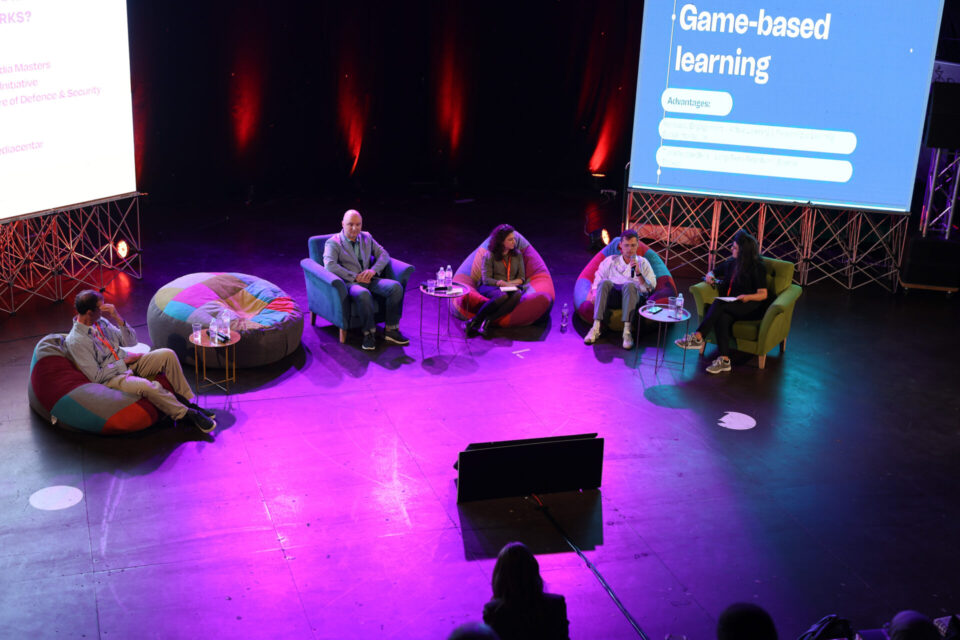
How can media literacy move beyond fact-checking to help people navigate today’s increasingly complex information environment? That was the focus of a panel discussion in mid-June at the POINT Conference in Sarajevo, one of Southeast Europe’s leading gatherings on democracy, technology, and civic engagement.
Transitions Executive Director Jeremy Druker joined experts from Estonia, Lithuania, and Lebanon/France to discuss how media literacy initiatives can better engage communities, build resilience, and become guides through the crowded and sometimes treacherous information space. The discussion explored approaches ranging from game-based learning and AI-powered educational tools to solutions journalism and “future literacy,” emphasizing the need to move beyond fear-based messaging and toward empowering citizens to engage constructively with their communities.
Jeremy argued that media literacy initiatives should avoid reinforcing fear and instead focus on constructive engagement. “We don’t want to do even more harm,” he said at the panel. “We try to design our programs based less on the threat and more on offering people hopeful alternatives.”
As Transitions continues to expand its media literacy work across Central and Southeastern Europe, the conference provided an opportunity to share lessons from our training programs while learning from innovative initiatives across the region. It was also a chance to celebrate the 25th anniversary of Zasto ne, the conference organizer. Originally established as a youth peace organization with the aim of working on the demilitarization of Bosnian society and establishing the right to conscientious objection in the country, the organization has grown into one of the region’s leaders in using civic tech to fight for government accountability.